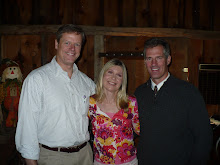
Scott Brown is going for the vacant Senate seat and last Saturday publicly stated his intentions to do so. The Boston Sunday Globe covered his announcement, but considering the placement of the article, it appears folks at The Globe are disappointed no Kennedy is running. Above the piece about State Senator Scott Brown is a story about Ted Kennedy Jr. who has not entered the race but is promoting his father's book, True Compass, reviewed in the same publication on pageK6. The Globe focus in terms of the Senate race is clearly on the Kennedy son and the author laments her plight of not having him as a contender for the Seat. Jenna Russell wistfully writes, "For a time, his story seemed destined to unfold in politics." (p.B6)
Coverage on Kennedy begins at the top of page B1 and continues on p. B6 with over half a page more text and pictures. On the front page of the Metro section where the write-up begins, directly above the article about Scott Brown, Ted Kennedy Jr. is pictured wiping a tear from his face as he spoke at his father's memorial service. Instead of publishing a photograph of the person who is putting himself on the line in this election, The Globe included a picture on that same page of someone who is not even involved. I will grant that on p.B4, under the fold, State Senator Brown is shown announcing his candidacy.
WGBH's "Greater Boston" Friday evening program, "Beat the Press" offers analysis of how events of the week were discussed and publicized. On that show (9/11/09) it was brought out that "the media wants a Kennedy to run." How can and do television, newspapers, talk show radio and the internet influence our thinking and in turn, our votes? We need to take care to sort through the mounds of information that are out there in order to get to the kernel of truth in order to make informed decisions.
Boston Sunday Globe, September 13, 2009, "Brown to make US Senate bid" by Peter Schworm, p.B1
http://www.boston.com/news/local/massachusetts/articles/2009/09/13/scott_brown_to_run_for_us_senate/
Boston Sunday Globe, September 13, 2009, "The Kennedy Mantle/ Son shuns spotlight, but not duty" by Jenna Russell, p.B1
http://www.boston.com/news/local/massachusetts/articles/2009/09/13/ted_kennedy_jr_shuns_spotlight_but_not_duty_to_fathers_memory/
Boston Sunday Globe, September 13, 2009, "Something to prove" by Matthew V. Storin, p.K6
http://www.boston.com/ae/books/articles/2009/09/13/ted_kennedys_memoir_recounts_his_achievements/
Tuesday, September 15, 2009

Tuesday, September 8, 2009
A hearing on the Democrats' proposal to change the law, handing power to the governor to choose an interim replacement for the vacant Senate seat, is scheduled for tomorrow at 1:00pm in Gardner Auditorium at the State House. Jennifer Nassour, Chair of the Massachusetts Republican Party, is organizing a protest to take place at the same time, same location. She asks those interested in participating to arrive at 11:30am.
Below is a portion of an unpublished letter Marshall Horwitz submitted to the Telegram & Gazette in December, 2008. Dr. Horwitz wrote this letter in support of State Representative Lew Evangelidis, who at the time, was running for House Minority Leader. In his letter, Marshall points out the need for a two-party system in Massachusetts. Could he have been any more clairvoyant?
With Joe Kennedy out of the running for his uncle's seat, the dynamics of the race change, however one-party dominance remains, allowing the Democrats on Beacon Hill to do nearly whatever they wish. Attend the hearing of the Joint Committee on Election Laws tomorrow.
Dr. Horwitz writes:
The most glaring need for a visible minority opposition can be seen in the events surrounding the 2004 and 2008 presidential election. In 2004, with Sen. John Kerry likely to become President, the state legislature stripped then Governor Romney of his authority to appoint an interim replacement for Senator Kerry’s seat. The Democratically controlled legislature sounded the populist clarion that so much power concentrated in the hands of the governor would deny the people of the Commonwealth the right to chose Senator Kerry’s successor. So a special election would be called. This charade, of course, was done to preclude Governor Romney his option to choose a member of the Republican Party, which he surely would have done. Just a few months ago, with Senator Kerry a potential nominee for the position of Secretary of State, the legislature floated the idea of returning the very same power removed from Governor Romney to Governor Patrick. There can only be one of two reasons for such a reversal of thought. Either the legislature has decided that the voters are not now qualified to make an intelligent decision in a special election, or since Governor Patrick would certainly choose a member of his party to replace Senator Kerry, it would be advantageous to avoid an election where even the remotest chance of a win by a Republican could exist. Clearly the latter is a far more logical explanation. The unchecked legislature once again carries on its own little fiefdom with no regard or respect for the people.
Just a few days ago, Senator Kennedy surrendered his post as chairman of the Senate Judiciary Committee. His ill heath makes it a possibility he might not complete his term which expires in 2012. Certainly the issue of his replacement could come up. And if it does, the strong money is on the legislature launching a pre-emptive strike and passing a bill allowing Governor Patrick to choose an interim senator.
The Boston Globe, Tuesday, September 8, 2009, "Kennedy says no, and race is on" by Frank Phillips, p.A1
Saturday, September 5, 2009
Once more Charlie Baker is in the news and again he talks common sense. After being criticized this past Thursday by Deval Patrick's spokesperson, Steve Crawford, for being silent on the issue of appointing an interim for the vacant Senate seat, Charlie Baker was vindicated by an article published in today's Telegram & Gazette, showing the current Governor's office was mistaken with their information. Glen Johnson of the Associated Press revisited an August 28th interview with Charlie Baker in which Mr. Baker offered his opinion about the controversy swirling around Kennedy's proposal to change the law. "'We have news coming out of (the Department of Revenue) that tax collections aren't living up to expectations. We have cities and towns with desperate budget situations with a myriad of proposals before the governor to more effectively manage their affairs. And we have senior-driver legislation that's been stalled for the better part of a year. Those feel like every bit as important an issue that probably deserves expedited attention, yet compared to this Senate discussion, they seem like an afterthought.'" (T & G, 9/5/09, p.A10) From that quotation it is reasonable to conclude that Mr. Baker has a handle on The Big Picture, a quality that defines a responsible and judicious chief executive.
Take a moment on this lazy Labor Day weekend to read Glen Johnson's full report in the T & G.
Telegram & Gazette, Saturday, September 5, 2009, "Succession talk spills into gov.'s race" by Glen Johnson of the Associated Press, p.A10
http://www.telegram.com/article/20090905/NEWS/909050519/1052
Take a moment on this lazy Labor Day weekend to read Glen Johnson's full report in the T & G.
Telegram & Gazette, Saturday, September 5, 2009, "Succession talk spills into gov.'s race" by Glen Johnson of the Associated Press, p.A10
http://www.telegram.com/article/20090905/NEWS/909050519/1052
Thursday, September 3, 2009
Representative Evangelidis To Host "Jordan Levy Show" Today
Tune in to AM 580, WTAG, to listen to State Representative Lew Evangelidis host "The Jordan Levy Show" today from 3:00 until 6:00 pm. Call in with a question at 508/755-0058.
Monday, August 31, 2009


While walking along the road today I chanced upon a pumpkin plant growing haphazardly over a stone wall. This is the third consecutive year a pumpkin has grown in that same spot, seemingly unplanned by any gardener, so perhaps my encounter wasn't truly based on luck. The yellow flowers, just beginning to bloom, many of them still closed and green, will soon produce their orange fruit, but for now remain empty.

Something about the air was different -- possibly it was the cool temperature or maybe the cloudy sky. Whatever the cause, a change in the atmosphere was unmistakable.
The end of August. That in between time. That disconnected juncture when the season starts to shift, when summer begins fading, yet cold days and nights remain somewhere in the distance.
Ovenbirds are yellow-brown "wood-warblers," (Sibley, p.448) with streaking on their bellies and a beautiful orange stripe on the crown of their heads. You must have a stroke of luck to see not only that orange stripe, but also the bird itself, as they like to scrum around in the underbrush of the forest floor. I didn't see an ovenbird on my walk, but its uneasy message, as spelled out by Robert Frost, was plain and as obvious as a barren pumpkin flower.
The Oven Bird
by Robert Frost
There is a singer everyone has heard,
Loud, a mid-summer and a mid-wood bird,
Who makes the solid tree trunks sound again.
He says that leaves are old and that for flowers
Mid-summer is to spring as one to ten.
He says the early petal-fall is past,
When pear and cherry bloom went down in showers
On sunny days a moment overcast;
And comes that other fall we name the fall.
He says the highway dust is over all.
The bird would cease and be as other birds
But that he knows in singing not to sing.
The question that he frames in all but words
Is what to make of a diminished thing.
The Poetry of Robert Frost, edited by Edward Connery Lathem, Holt, Rinehart and Winston, New York, 1969, pp.119 - 120.
The Sibley Guide to Birds by David Allen Sibley, Alfred A. Knopf, New York, 2001, p.448
Wednesday, August 5, 2009
". . . as big as the end of your thumb," ~Robert Frost


 Representative Anne Gobi, Democrat from Spencer, has written legislation that if passed, would create a position for a state poet laureate. In uncertain times, people look for inspiration and comfort, or for something larger and beyond themselves. Not only that, but Massachusetts not having a special person appointed to direct our attention to poetry seems out of sync with who we are as a Commonwealth, especially considering our history of fostering poets, as Craig Semon pointed out in his front page article in yesterday's T & G.
The main assignment of this unpaid position, as stated in Ms. Gobi's proposed bill would be to "'act as a public emissary and advocate for poetry in the state'". Francine D'Alessandro, past president of the Worcester County Poetry Association, suggests that the person selected "'needs to be someone who will celebrate poetry from one end of the state to the next,'" according to the T & G, 8/4/09, p.A8.
Mr. Semon begins his story on p.A1 by quoting Robert Frost, a New England poet. "'A poem begins in delight and ends in wisdom.'" Although the blueberries shown above aren't all necessarily at their prime picking stage, when photographed last week they were a feast to the eye and to the taste. Reading on you will discover that Robert Frost's poem "Blueberries"enriches and sweetens the mind and the soul, and if you look closely enough you might discover a political thought intertwined in his lines as well, particularly towards the close.
Let's start the search for the new Massachusetts Poet Laureate.
Blueberries
By Robert Frost
“You ought to have seen what I saw on my way
To the village, through Patterson’s pasture today:
Blueberries as big as the end of your thumb,
Real sky-blue, and heavy, and ready to drum
In the cavernous pail of the first one to come!
And all ripe together, not some of them green
And some of them ripe! You ought to have seen!”
“I don’t know what part of the pasture you mean.”
“You know where they cut off the woods – let me see –
It was two years ago – or no! – can it be
No longer than that? – and the following fall
The fire ran and burned it all up but the wall.”
“Why, there hasn’t been time for the bushes to grow,
That’s always the way with the blueberries, though:
There may not have been the ghost of a sign
Of them anywhere under the shade of the pine,
But get the pine out of the way, you may burn
The pasture all over until not a fern
Or grass-blade is left, not to mention a stick,
And presto, they’re up all around you as thick
And hard to explain as a conjuror’s trick.”
“It must be on charcoal they fatten their fruit.
I taste in them sometimes the flavor of soot.
And after all, really they’re ebony skinned:
The blue’s but a mist from the breath of the wind,
A tarnish that goes at a touch of the hand,
And less than the tan with which pickers are tanned.”
“Does Patterson know what he has, do you think?”
“He may and not care, and so leave the chewink
To gather them for him – you know what he is.
He won’t make the fact that they’re rightfully his
An excuse for keeping us other folk out.”
“I wonder you didn’t see Loren about.”
“The best of it was that I did. Do you know,
I was just getting through what the field had to show
And over the wall and into the road,
When who should come by, with a democrat-load
Of all the young chattering Lorens alive,
But Loren, the fatherly, out for a drive.”
“He saw you, then? What did he do? Did he frown?”
“He just kept nodding his head up and down.
You know how politely he always goes by.
But he thought a big thought – I could tell by his eye-
Which being expressed, might be this in effect:
‘I have left those there berries, I shrewdly suspect,
To ripen too long. I am greatly to blame.’”
“He’s a thriftier person than some I could name.”
“He seems to be thrifty; and hasn’t he need,
With the mouths of all those young Lorens to feed?
He has brought them all up on wild berries, they say,
Like birds. They store a great many away.
They eat them the year round, and those they don’t eat
They well in the store and buy shoes for their feet.”
“Who cares what they say? It’s a nice way to live,
Just taking what Nature is willing to give,
Not forcing her hand with harrow and plow.”
“I wish you had seen his perpetual bow –
And the air of the youngsters! Not one of them turned,
And they looked so solemn-absurdly concerned.”
“I wish I knew half what the flock of them know
Of where all the berries and other things grow,
Cranberries in bogs and raspberries on top
Of the boulder-strewn mountain, and when they will crop.
I met them one day and each had a flower
Stuck into his berries as fresh as a shower;
Some strange kind – they told me it hand’t a name.”
“I’ve told you how once, not long after we came,
I almost provoked poor Loren to mirth
By going to him of all people on earth
To ask if he knew any fruit to be had
For the picking. The rascal, he said he’d be glad
To tell if he knew. But the year had been bad.
There had been some berries – but those were all gone.
He didn’t say where they had been. He went on:
‘I’m sure – I’m sure’ – as polite as could be.
He spoke to his wife in the door, ‘Let me see,
Mame, we don’t know any good berrying place?’
It was all he could do to keep a straight face.”
“If he thinks all the fruit that grows wild is for him,
He’ll find he’s mistaken. See here, for a whim,
We’ll pick in the Pattersons’ pasture this year.
We’ll go in the morning, that is, if it’s clear,
And the sun shines out warm: the vines must be wet.
It’s so long since I picked I almost forget
How we used to pick berries: we took one look round,
Then sank out of sight like trolls underground,
And saw nothing more of each other, or heard,
Unless when you said I was keeping a bird
Away from its nest, and I said it was you.
‘Well, one of us is.’ For complaining it flew
Around and around us. And then for a while
We picked, till I feared you had wandered a mile,
And I thought I had lost you. I lifted a shout
Too loud for the distance you were, it turned out,
For when you made answer, your voice was as low
As talking – you stood up beside me, you know.”
“We shan’t have the place to ourselves to enjoy –
Not likely, when all the young Lorens deploy.
They’ll be there tomorrow, or even tonight.
They won’t be too friendly – they may be polite –
To people they look on as having no right
To pick where they’re picking. But we won’t complain.
You ought to have seen how it looked in the rain,
The fruit mixed with water in layers of leaves,
Like two kinds of jewels, a vision for thieves.”
The Poetry of Robert Frost , edited by Edward Connery Lathem, Holt, Rinehart and Winston, New York, 1969, “Blueberries”, pp. 59 – 62.
Telegram & Gazette, Tuesday, August 4, 2009, "Roses are red, budgets are blue . . . " by Craig Semon, p.A1
http://www.telegram.com/article/20090804/NEWS/908040393/1160/SPECIALSECTIONS04&source=rss
Subscribe to:
Posts (Atom)